

Notes for UPSC CSE (GS-3) & State PCS
1. Why in News? / खबरों में क्यों?
- ILO Convention No. 193: The International Labour Organization (ILO) adopted Convention No. 193, titled ‘Decent Work in the Platform Economy’. This is the first legally binding international treaty covering app-based gig/platform workers (delivery riders, drivers, data-labellers, etc.).
- Voting Outcome: Adopted with 406 votes in favour, 8 against, and 36 abstentions.
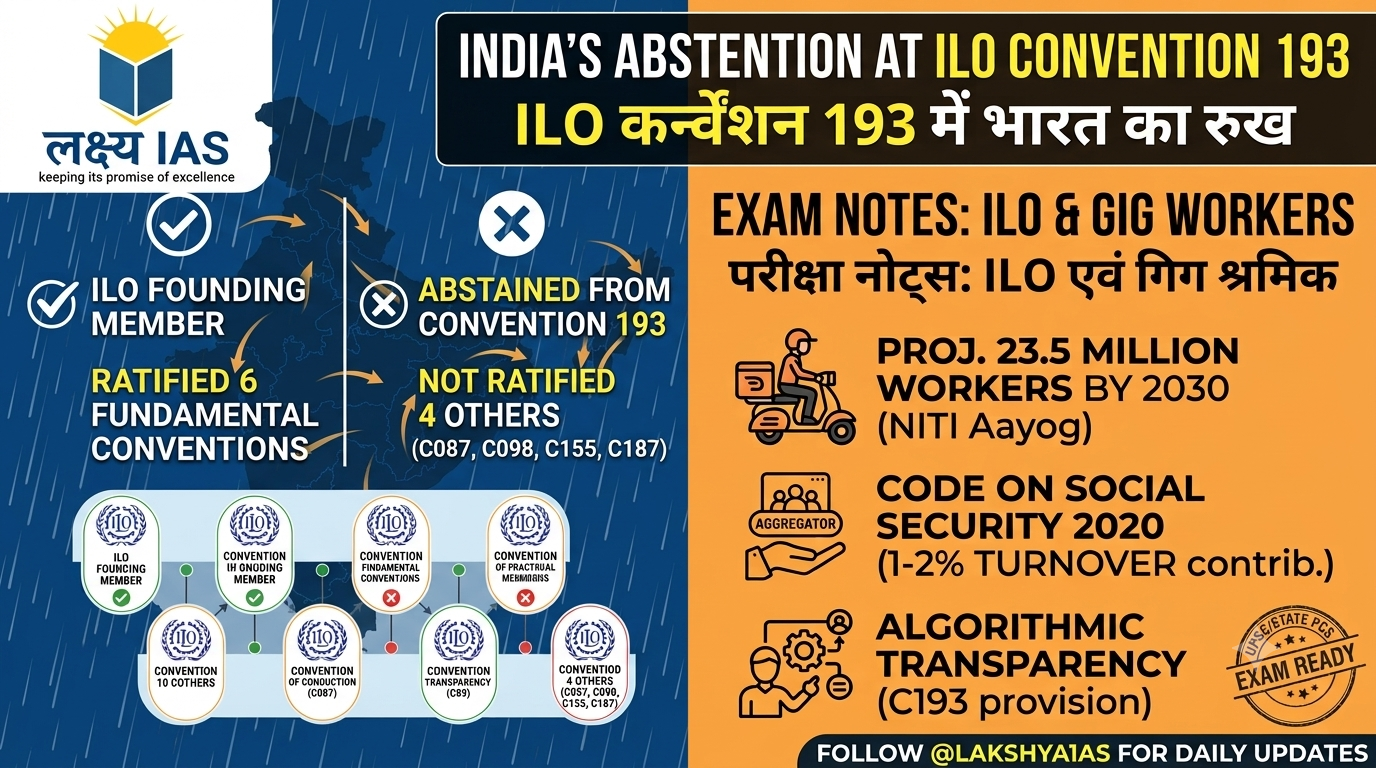
- India’s Stance: The Government of India abstained from voting.
2. Key Provisions of Convention No. 193 / कन्वेंशन 193 के मुख्य प्रावधान
- Universal Floor of Rights: Guarantees basic rights to platform workers regardless of whether companies classify them as “independent contractors” or “employees”.
- Algorithmic Transparency: Regulates opaque algorithms that assign work, track performance, and deactivate accounts. Mandates written explanations for automated decisions and requires a “human in the loop” for critical choices.
- Core Rights: Includes statutory minimum wage floor, timely payouts, occupational safety and health (OSH), and social security.
- Primacy of Facts (Article 9): Directs governments to classify workers based on actual work performance rather than contract wording.
3. Data & Domestic Legal Framework / आंकड़े और घरेलू कानूनी ढांचा
Gig Economy Data (NITI Aayog & World Bank)
- India’s Gig Workforce: Stood at 7.7 million (2020-21); projected to reach 23.5 million by 2029-30 (~6.7% of India’s non-agricultural workforce).
- Social Security Gap: NITI Aayog notes that only 15% of Indian gig workers have any form of social security coverage.
- Global Scale: World Bank estimates 154–435 million people globally rely on platform work.
Indian Legal Context
- Code on Social Security, 2020: Enforced in November 2025. Explicitly defined “gig worker” and “platform worker”. Directs aggregators to contribute 1%–2% of annual turnover (capped at 5% of worker payouts) toward a social security fund.
- 7th Schedule / State Role: Labour is a Concurrent Subject (List III). States like Rajasthan (Platform-Based Gig Workers Act, 2023), Karnataka, and Telangana have drafted separate welfare frameworks.
4. Static GS Fact-Sheet: International Labour Organization (ILO)
- Established: 1919 by the Treaty of Versailles; became the first UN specialized agency in 1946.
- Headquarters: Geneva, Switzerland.
- Structure: Unique Tripartite Structure (Governments, Employers, Workers).
- India’s Status: India is a Founding Member of the ILO.
10 Fundamental ILO Conventions & India’s Ratification Status
(Note: ILO expanded its fundamental conventions from 8 to 10 in 2022 by adding Occupational Safety & Health conventions)
| No. | ILO Convention Name | विषय (Subject) | India’s Ratification Status |
| C029 | Forced Labour Convention (1930) | जबरन श्रम का निषेध | Ratified (अनुसमर्थित) |
| C087 | Freedom of Association & Protection of the Right to Organise (1948) | संघ बनाने की स्वतंत्रता | NOT Ratified (नहीं किया) |
| C098 | Right to Organise and Collective Bargaining (1949) | सामूहिक सौदेबाजी का अधिकार | NOT Ratified (नहीं किया) |
| C100 | Equal Remuneration Convention (1951) | समान पारिश्रमिक | Ratified (अनुसमर्थित) |
| C105 | Abolition of Forced Labour Convention (1957) | जबरन श्रम का उन्मूलन | Ratified (अनुसमर्थित) |
| C111 | Discrimination (Employment and Occupation) (1958) | रोज़गार में भेदभाव का निषेध | Ratified (अनुसमर्थित) |
| C138 | Minimum Age Convention (1973) | न्यूनतम आयु (बाल श्रम) | Ratified (2017 में किया) |
| C182 | Worst Forms of Child Labour Convention (1999) | बाल श्रम के निकृष्टतम रूप | Ratified (2017 में किया) |
| C155 | Occupational Safety and Health Convention (1981) | व्यावसायिक सुरक्षा और स्वास्थ्य | NOT Ratified (नहीं किया) |
| C187 | Promotional Framework for OSH Convention (2006) | OSH हेतु प्रोत्साहन ढांचा | NOT Ratified (नहीं किया) |
Why hasn’t India ratified C087 & C098?
Ratifying these conventions would grant government servants the statutory right to form trade unions, bargain collectively, and go on strike, which conflicts with Indian Civil Services Conduct Rules.
5. UPSC Prelims Exam Traps (परीक्षा के लिए महत्वपूर्ण जाल)
- TRAP 1: ILO Tripartite Voting Mechanism
- Examiner Trap: “India voted against Convention No. 193.”
- Fact Check: False. India abstained. Furthermore, due to the ILO’s tripartite structure, only India’s Government delegate abstained; Indian Employer and Worker delegates voted IN FAVOUR.
- TRAP 2: Ratification Stance on Fundamental Conventions
- Examiner Trap: “India has ratified all fundamental conventions of the ILO.”
- Fact Check: False. India has ratified 6 out of the 10 fundamental conventions. It has not ratified C087, C098, C155, or C187.
- TRAP 3: Legal Jurisdiction of Labour Laws
- Examiner Trap: “Regulation of gig and platform workers falls exclusively under the Union List in the 7th Schedule.”
- Fact Check: False. Labour is in the Concurrent List (List III). State governments can pass independent legislation regulating platform work (e.g., Rajasthan Platform-Based Gig Workers Act 2023).
- TRAP 4: Binding Nature of ILO Instruments
- Examiner Trap: “ILO Declarations and Conventions are both non-binding guidelines.”
- Fact Check: False. ILO Conventions are legally binding international treaties once ratified by a member state. Recommendations and Declarations are non-binding guidelines.