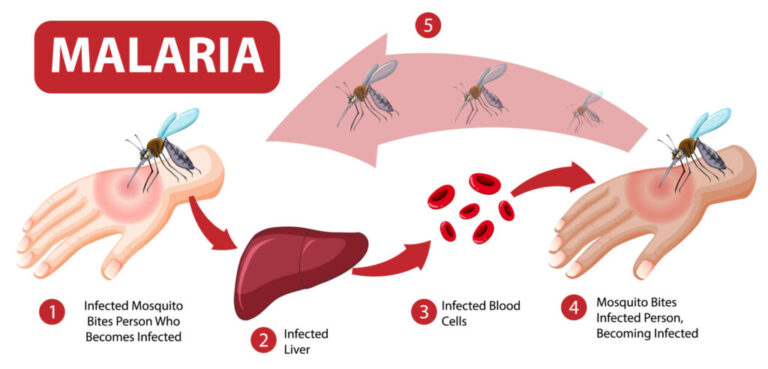
Recent context (हालिया प्रसंग) : A recent study titled “Pan-India Molecular Surveillance of Dengue Serotypes, 2023–2025” by the ICMR Virus Research and Diagnostic Laboratory (VRDL) network highlights a critical shift in India’s dengue landscape.
1. Key Highlights: ICMR Dengue Study (हालिया ICMR अध्ययन)
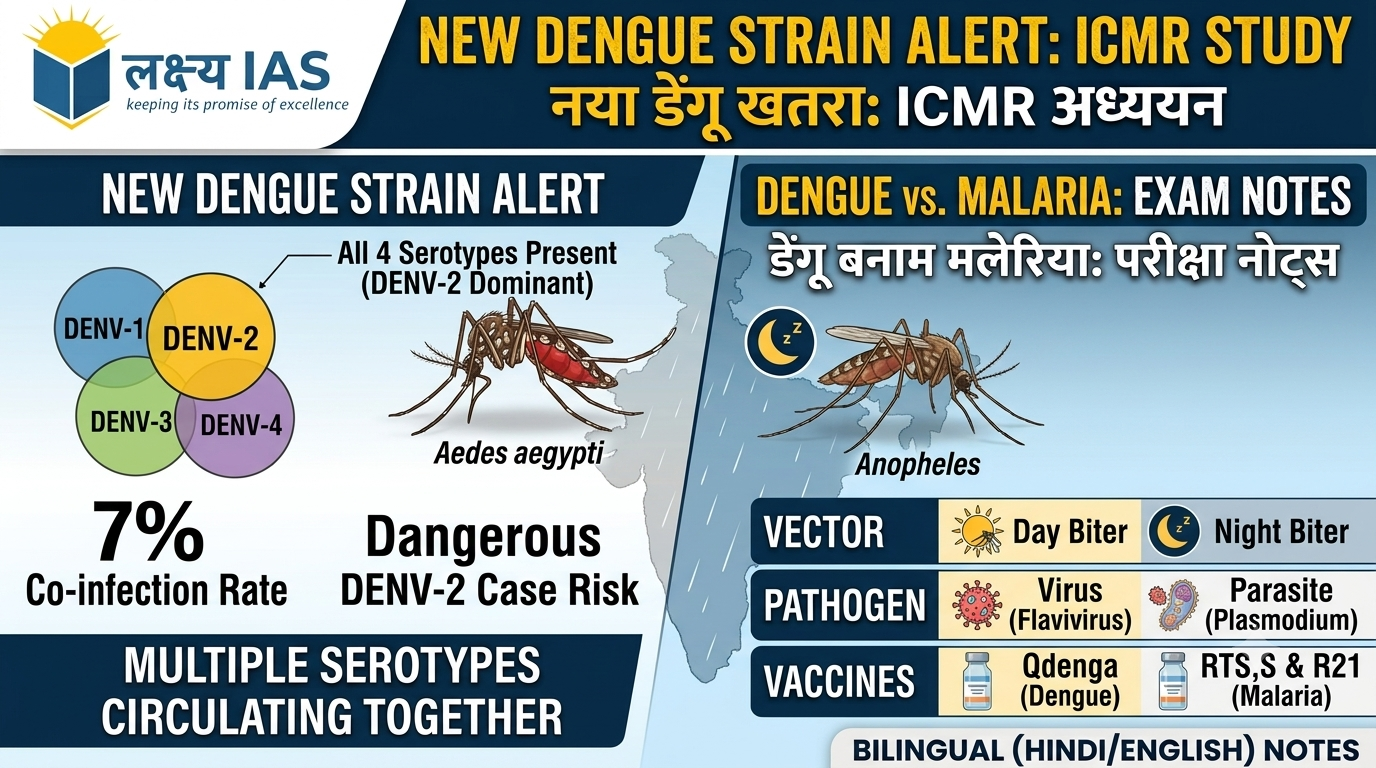
- Hyper-endemicity (अति-स्थानिकता): All 4 dengue virus serotypes (DENV-1, DENV-2, DENV-3, DENV-4) are now circulating simultaneously across multiple states in India.
- Dominant Serotype: DENV-2 remains the predominant strain, accounting for over 50% of all infections.
- Co-infections (दोहरे संक्रमण): Nearly 1 in 14 patients (~7%) was found infected with more than one serotype concurrently, significantly raising the risk of severe disease (dengue shock syndrome, severe internal bleeding, dangerously low platelet count).
- Vaccine Status in India:
- Qdenga (TAK-003): An internationally approved live-attenuated tetravalent dengue vaccine developed by Takeda has received regulatory clearance for import/sale in India.
- UIP Inclusion: India currently has NO dengue vaccine included in its Universal Immunisation Programme (UIP).
2. Static Information: Dengue vs. Malaria (डेंगू बनाम मलेरिया)
| Parameter (मानदंड) | Dengue (डेंगू) | Malaria (मलेरिया) |
| Pathogen Type (रोगाणु प्रकार) | Virus (Flavivirus / Single-stranded RNA virus) | Protozoan Parasite (Plasmodium genus) |
| Strains / Species (प्रजातियां) | 4 Serotypes: DENV-1, DENV-2, DENV-3, DENV-4 | P. falciparum (most severe), P. vivax, P. malariae, P. ovale |
| Primary Vector (प्रमुख वाहक) | Female Aedes aegypti mosquito (also Aedes albopictus) | Female Anopheles mosquito |
| Biting Pattern (काटने का समय) | Daytime biter (Peak activity early morning & before sunset) | Night biter (Active mainly from dusk to dawn) |
| Breeding Grounds (प्रजनन स्थल) | Stagnant clean water in artificial containers (coolers, tires, pots) | Stagnant water bodies (puddles, slow streams, ditches) |
| Key Biological Impact (मुख्य जैविक प्रभाव) | Severe drop in Platelet count (Thrombocytopenia) | Destroys Red Blood Cells (RBCs) leading to anemia & jaundice |
| Globally Available Vaccines (उपलब्ध टीके) | 1. Qdenga (TAK-003) – Takeda 2. Dengvaxia (CYD-TDV) – Sanofi Pasteur | 1. RTS,S/AS01 (Mosquirix) – GSK 2. R21/Matrix-M – Univ. of Oxford / Serum Institute |
| India’s UIP Status (भारत का UIP) | Not included in UIP | Not included in UIP |
3. UPSC Prelims Elimination & Exam Traps (परीक्षक के जाल)
📌 Trap 1 (Pathogen Misclassification): UPSC often swaps vector/pathogen types. Dengue is Viral, while Malaria is Protozoan. Chikungunya and Zika are also viral (transmitted by Aedes).
📌 Trap 2 (Vector Behavior): Aedes aegypti (Dengue/Chikungunya/Zika) is a daytime biter, whereas Female Anopheles (Malaria) feeds between dusk and dawn.
📌 Trap 3 (Vaccine Match):
- Mosquirix and R21/Matrix-M are vaccines for Malaria, not Dengue.
- Qdenga (TAK-003) is a tetravalent vaccine for Dengue.
📌 Trap 4 (UIP Status): Neither Dengue nor Malaria vaccines are currently part of India’s Universal Immunisation Programme (UIP).
4. Practice Question for Revision (अभ्यास प्रश्न)
Q. With reference to vector-borne diseases in India, consider the following statements:
- Dengue is caused by a protozoan parasite, whereas Malaria is caused by an RNA virus.
- The Aedes aegypti mosquito, which transmits Dengue, primarily bites during daylight hours.
- R21/Matrix-M is a WHO-recommended vaccine developed for Dengue prevention.
Which of the statements given above is/are correct?
(a) 1 and 2 only
(b) 2 only
(c) 2 and 3 only
(d) 1, 2, and 3
Answer: (b) 2 only
Explanation: Statement 1 is incorrect because Dengue is viral and Malaria is protozoan. Statement 3 is incorrect because R21/Matrix-M is a vaccine for Malaria, not Dengue. Statement 2 is factually correct.