BRICS (Brazil, Russia, India, China, South Africa) — UPSC & State PCS High-Yield Revision One-Pager
Subject: GS Paper II (International Relations / अंतर्राष्ट्रीय संबंध)
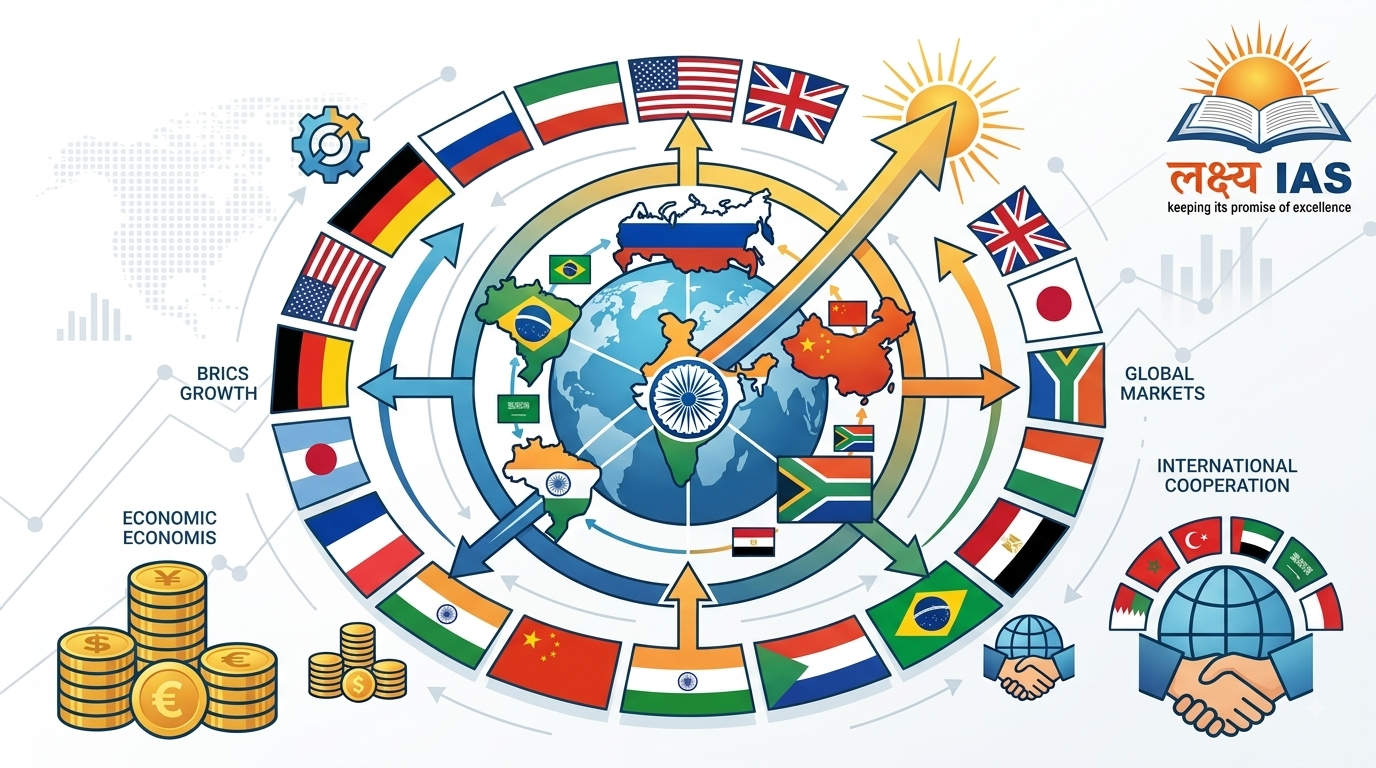
BRICS accounts for over 45% of the global population and nearly 36% of global GDP (PPP), functioning as a critical economic and geopolitical bloc for driving global governance reform.
📌 At a Glance / एक नज़र में
| Feature | Key Details / मुख्य विवरण |
|---|---|
| Origin (उत्पत्ति) | Term coined in 2001 by Jim O’Neill (Goldman Sachs). Formalised as BRIC in 2006. First Summit: 2009 (Yekaterinburg). |
| Expansion (विस्तार) | South Africa joined in 2010 (BRICS). Expanded in 2024 (BRICS+): Egypt, Ethiopia, Iran, UAE joined. |
| Secretariat (सचिवालय) | No Permanent Secretariat (Presidency rotates annually alphabetically). |
| Key Institutions (प्रमुख संस्थान) | New Development Bank (NDB) (HQ: Shanghai) & Contingent Reserve Arrangement (CRA). |
| NDB Voting Power | Equal voting rights (20% each among founding members; no country has veto power). |
🎯 Aims & Objectives (लक्ष्य एवं उद्देश्य)
- Economic Cooperation (आर्थिक सहयोग): Promote trade, investment, and infrastructure development among global South economies.
- Global Governance Reform (वैश्विक शासन सुधार): Demand reform of Western-dominated institutions like the UN Security Council (UNSC), IMF, and World Bank.
- Multipolarity (बहुध्रुवीयता): Foster a multipolar world order based on international law and sovereign equality.
- South-South Cooperation (दक्षिण-दक्षिण सहयोग): Strengthen financial integration and sustainable development across developing nations.
💡 Recent Context: India’s Stance on BRICS Currency (ब्रिक्स मुद्रा पर भारत का रुख)
A central discussion within BRICS is De-dollarization (वि-डॉलरीकरण)—reducing reliance on the US Dollar in international trade. However, India maintains a clear, nuanced position regarding a unified BRICS currency:
- Opposition to Common Currency: India explicitly does not support a single, common BRICS currency.
- Focus on Local Currencies (स्थानीय मुद्रा में व्यापार): India advocates for national currency settlement mechanisms (e.g., Rupee-Dirham or Rupee-Rouble trade) and strengthening domestic financial infrastructure.
- Why India Opposes a BRICS Currency:
- Chinese Yuan Dominance: A unified currency would likely be dominated by the Chinese Renminbi (RMB), increasing economic leverage for Beijing.
- Monetary Autonomy (मौद्रिक स्वायत्तता): A shared currency strips the Reserve Bank of India (RBI) of its independent monetary policy tools.
- Macroeconomic Divergence: Member economies have vast differences in growth rates, inflation, and trade structures, making a single monetary policy impractical.
🛑 Shortcomings & Challenges (कमियां एवं चुनौतियां)
- Bilateral Friction (द्विपक्षीय तनाव): High-stakes disputes, particularly the Sino-Indian border issues, undermine internal consensus.
- Heterogeneous Political Systems: Combines vibrant democracies (India, Brazil, South Africa) with non-democratic regimes (China, Russia, Iran), creating values divergence.
- Perception of Anti-Western Bloc: The inclusion of Iran and Russia’s geopolitical posture risks framing BRICS as Anti-West rather than Non-West, which conflicts with India’s foreign policy of non-alignment and strategic autonomy.
- Implementation Gap: High-level declarations often lack concrete timelines and binding enforcement mechanisms.
🔭 Way Forward (आगे की राह)
- Maintain a “Non-Western” Identity: Ensure BRICS remains a platform for reform and economic cooperation rather than an anti-Western confrontation alliance.
- Strengthen Interoperable Payment Systems: Expand cross-border integration of national payment networks (e.g., India’s UPI, UAE’s Jaywan) instead of creating a unified currency.
- Focus on NDB Funding: Scale up green infrastructure financing through the New Development Bank for Global South projects.
🚨 UPSC Prelims Elimination Rules & Traps (परीक्षा उपयोगी ट्रिक्स)
- ❌ Trap 1: “BRICS has a permanent headquarters in Shanghai.”
👉 Fact: FALSE. BRICS itself has no permanent secretariat. Only the New Development Bank (NDB) is headquartered in Shanghai. - ❌ Trap 2: “Voting power in the New Development Bank (NDB) is proportional to GDP capital share like the World Bank.”
👉 Fact: FALSE. Unlike the IMF/World Bank, all founding members hold equal voting rights (20%) in NDB. - ❌ Trap 3: “India has agreed to launch a common BRICS currency by 2030.”
👉 Fact: FALSE. India favors trade settlement in national local currencies and opposes a unified BRICS currency.